The Basics?
We need it. LOTS of it! When our country fails to produce enough (read: DOMESTIC production) we have to rely on foreign sources (read: MIDDLE EAST). Reliance upon and aggressive pursuit of foreign oil sources has been a heated controversy as of late.
Where do we get our Domestic Oil?
Traditionally, Alaska has been a fantastic source of oil within the United States. One of the more famous sites of domestic oil is Prudhoe Bay (also one of the first drilling sites in Alaska). Prudhoe produces the most oil of any domestic oil field in the country, and thereby has become the example for both the proponents and opponents of further drilling.
Further Drilling?
Yes, unfortunately Prudhoe Bay is no longer at its peak for production, and other sources of domestic oil are being enthusiastically searched out to replace this dwindling resource. This pursuit has encompassed endless numbers of explorers, researchers, scientists and, at this late stage in the game, has become a major point of interest on Capitol Hill. The most current (and most promising) find in the race to secure domestic oil is the treasure trove known as the Arctic National Wildlife Refuge, or ANWR, for short.
Arctic National Wildlife Refuge (ANWR)
As seen in the map below, ANWR is a sectioned-off portion of Alaska along the Northeastern coastline and border. Prudhoe Bay is seen in gray to the west of ANWR, and a note of particular interest is the Trans-Alaska Pipeline (or TAPS) situated just miles west of ANWR. This line is used to pump the oil from Prudhoe Bay down to be processed and used in the continental United States. Sitting only miles from TAPS, the oil from ANWR will easily be transported down the same pipeline requiring only minor additions to existing piping!
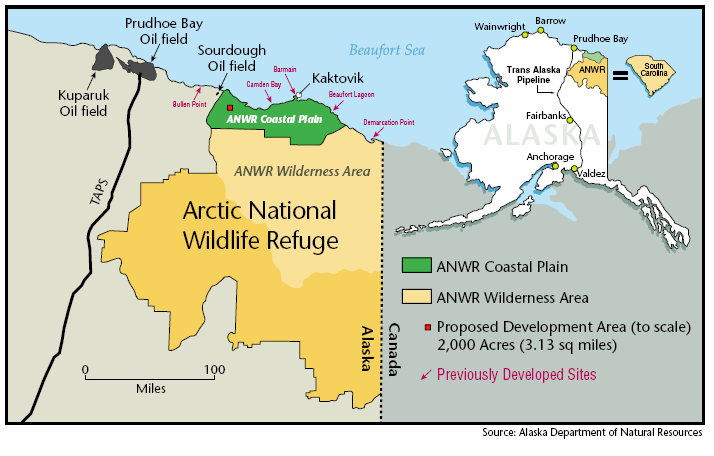 The National Geographic magazine recently published a series of articles related to the Arctic National Wildlife Refuge and the current debate on whether or not this abundant source should be used to bolster our domestic market. The principle article, Oil Field or Sanctuary by John G. Mitchell, acknowledges the resources that could be attained by drilling Alaska's ANWR, but raises a concern that many biologists in the area share: the footprint of the oil field could have harsh negative effects on the Porcupine Caribou found naturally in this habitat.
"If there is any issue more contentious than the amount of oil likely to be found beneath the coastal plain, it is the extent to which the infrastructure necessary to extract it—roads, airstrips, drilling pads—might adversely affect habitat essential to some 200 species of birds and mammals, including the barren-ground caribou of the Porcupine herd" (Mitchell)
This issue is put to rest by many sources. ANWR.org, a site dedicated to this refuge, states that "only 8% of ANWR would be considered for exploration," further clarifying:
"Only the 1.5 million acre or 8% on the northern coast of ANWR is being considered for development. The remaining 17.5 million acres or 92% of ANWR will remain permanently closed to any kind of development. If oil is discovered, less than 2000 acres of the over 1.5 million acres of the Coastal Plain would be affected. That's less than half of one percent of ANWR that would be affected by production activity."
Janet Pelley, in her peer-reviewed article on the disruption oil drilling may cause, reassures the community that "lessons learned over the past 30 years, combined with new technology, allow engineers to design oil fields with no negative impact on wildlife." She also highlights Phillip Alaska, Inc.'s Mike Joyce (manager of Biological Sciences). Joyce admits that the almost 50-year old technology used at Prudhoe Bay is effective, but rather dated, and leaves a broader footprint on the environment. "Oil fields in the Arctic National Wildlife Refuge will not look like Prudhoe Bay and will not stress the caribou," he states.
Phillip Alaska, Inc. is just one of many companies on Alaska's north slope conducting exhaustive research to ensure the safety of the wildlife. BP, an easily recognizable company in the petroleum industry, spends "between $5 million and $10 million each year on environmental research," according to a report by Bill Streever for BioScience. Streever indicates that "the results of the research contribute to improved environmental stewardship on the North Slope [of Alaska]." And truly, this is the answer.
Solution to the Debate
Until significant findings occur in the realm of alternative fuels, we, as an American people, need petroleum-based fuels. The most abundant findings are situated in remote, nearly barren parts of the Alaskan borders. Drilling for oil will boost our economy as it provides jobs for those in need, domestic petroleum to ween us off our dependence on foreign imports, and combustible energy to fuel the Nation.
The only concern is the environmental footprint left by the drilling operation. Opponents of the drilling point to the Porcupine Caribou as the herd with most to lose by the drilling. As proved by many independent researchers, improvements in technology (including directional drilling and ice roadways [search each term through our friends at Google for further clarification]) have reduced this footprint to the point that our engineers can "design oil fields with no negative impact on wildlife" (Pelley).
Streever's words ring clear once more. "Environmental stewardship" is the key to our success and the most powerful compromise between the dueling parties. If we can only remember our stewardship for the environment, we can utilize the Earth as the abundant resource that it was intended to be for the human race, while also tending to our duties as protectors and caregivers of the animals with which we share this existence.
The oil harvested in the Arctic National Wildlife Refuge will sustain our lives, and our careful stewardship will maintain the livelihood of the great Porcupine caribou.
Mitchell, John G. "In Focus: Arctic National Wildlife Refuge: Oil Field or Sanctuary?" National Geographic (August 2001), 46-55.
Pelley, Janet. "Will drilling for oil disrupt the Arctic National Wildlife Refuge?" Environmental Science and Technology (2001), 240A-247A.
Streever, Bill. "Science and Emotion, On Ice: The Role of Science on Alaska's North Slope" BioScience (2002), 179-184.

No comments:
Post a Comment